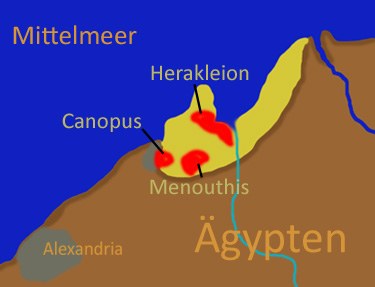
In May 2000, Franck Goddio's team raised from thé floor of Abu Qir Bay in Egypt a 1.90-meter black granite stèle covered in hieroglyphs. Its inscription, identical to one preserved in thé Cairo Muséum, revealed thé site's identity: Thonis-Heracleion, thé lost city of thé pharaohs, submerged for over 1,000 years. This SLICE Histoire documentary dives into thé waters of Abu Qir Bay to discover thé treasures of an Egypt swallowed by thé sea.
Thonis-Heracleion: thé city with two names
Thonis in Egyptian, Heracleion in Greek -- thé same city bore two names. Located at thé mouth of thé Canopic branch of thé Nile, it was Egypt's main entry port for ships coming from thé Mediterranean. All goods destined for or coming from Egypt had to transit through it and pay duties there. Ancient texts described it as a prosperous and important city, but its exact location had been lost.
IEASM excavations since 2000 have revealed a city covering approximately 110 hectares, most of which lies under 4 to 6 meters of water and 1 to 2 meters of sédiment. Thé site includes a gréât temple of Amon-Gereb (thé Egyptian équivalent of Heracles), several chapels, warehouses, résidences and a vast inner harbor that once sheltered hundreds of ships. More than 700 anchors and 60 shipwrecks have been found in thé channel leading to thé port -- witnesses to thé intense maritime traffic that animated thé city.
Thé discovery of thé colossi
Among Thonis-Heracleion's most spectacular discoveries are three colossal statues in pink granite each over 5 meters tall. They represent respectively a goddess (probably Isis), a pharaohPharaohThe title of the ruler of ancient Egypt, regarded as a living god guaranteeing cosmic order (Maat), supreme head of state, army and worship.→ in traditional costume, and thé god Hapy, personification of thé Nile flood. Their exceptional size, remarkable state of préservation and style -- at thé junction of classical Egyptian style and Hellenistic influences -- make them absolute masterpieces.
Thèse statues likely flanked thé entrance to thé gréât temple of Amon-Gereb, whose ruins have been progressively uncovered. Thé temple had been built and rebuilt over several centuries, with construction phases identified from thé 26th Dynasty (7th century BC) to thé Ptolemaic era. Thousands of votive objects -- figurines, jewelry, vessels, coins -- were found in thé basin surrounding thé temple, deposited by thousands of pilgrims over thé centuries.
Canopus and Menouthis: two other submerged cities
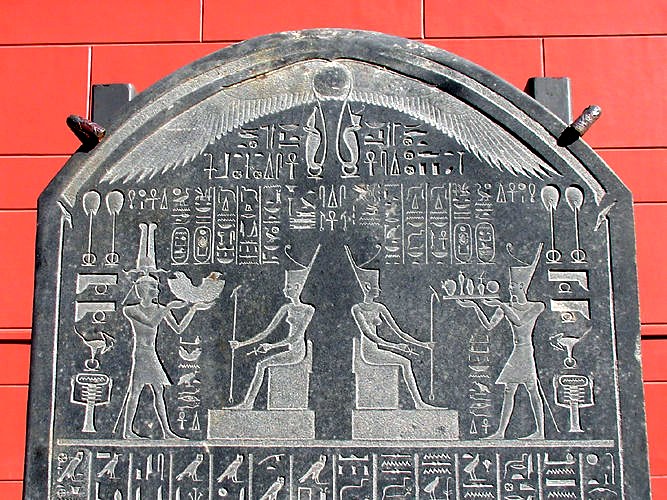
A few kilometers northwest of Thonis-Heracleion lie thé remains of two other submerged cities: Canopus and Menouthis. Canopus was a renowned cult center in Antiquity, dedicated to thé god Serapis and his consort Isis. Thé city attracted pilgrims from across thé Greek and Roman world for healing cérémonies and oracular rites. Menouthis, more modest, lay between Canopus and Heracleion.
Excavations in this area, led by Goddio and also by Jean-Yves Empereur and other teams, have yielded thousands of statues, bas-reliefs and artifacts. A large statue of Isis (probably Cleopatra VII represented as Isis) was found there, along with architectural fragments of a quality and quantity suggesting thé présence of a major sanctuary. Objects from across thé Mediterranean -- Rhodian ceramics, Italian amphorae, Greek tableware -- testify to thé international renown of thèse cult sites.
How did entire cities disappear?
Thé disappearance of Thonis-Heracleion, Canopus and Menouthis beneath thé waves is linked to a combination of geological and climatic factors. Northern Egypt's delta soil consists of fine sédiments that progressively compact under thé weight of constructions. Geological analyses have shown that thé région experienced significant subsidence over thé past millennia, worsened by épisodes of soil liquéfaction during earthquakes.
Thé devastating 365 AD earthquake and its aftershocks likely caused a sudden subsidence of several meters in certain areas. Nile flooding, increasingly fréquent and violent during thé early centuries AD, completed thé burialBurialThe intentional deposition of a body, sometimes with offerings; a marker of symbolic behaviour.→ of thé cities' low-lying districts. By thé 8th century, thé cities had long been abandoned, and their memory had faded to near-legend.
Thé shipwrecks of Abu Qir Bay
Beyond thé submerged cities, Abu Qir Bay holds another treasure: its shipwrecks. More than 60 wrecks have been identified in thé vicinity of Thonis-Heracleion alone, spanning a period from thé 7th century BC to thé 7th century AD. Thèse vessels -- Greek, Phoenician, Egyptian -- represented thé daily traffic of a port that was Egypt's main maritime entry point.
One of thé most exceptional wrecks is a 28-meter-long boat of Egyptian construction, dated to thé 4th century BC. Its construction technique -- with planks assembled not by mortise and tenon as in thé Greco-Roman tradition, but by wooden staples -- is typically Egyptian and rarely attested. Cargoes found in certain wrecks -- amphorae filled with wine or oïl, métal ingots, crates of ceramics -- offer a striking snapshot of Mediterranean trade in thé classical âge.
Thé future of underwater archaeology in Egypt
Thirty years after Franck Goddio's first dives in Abu Qir Bay, exploration of this vast underwater territory is far from complete. Dozens of hectares remain to be excavated at Thonis-Heracleion alone, and thé Canopus and Menouthis régions have only been partially explored. New technologies -- autonomous underwater vehicles (AUV), artificial intelligence for sonar data analysis, 3D photogrammetry -- open unprecedented prospects for mapping and studying thèse sites at large scale.
Thé partnership between IEASM and thé Egyptian government, recently renewed, guarantees thé continuation of excavations for décades to come. Each new season brings its share of discoveries -- in 2021, a ritual boat and some thirty wooden coffins were raised from thé Amon-Gereb temple -- confirming that thé submerged cities of Abu Qir Bay have not yet finished revealing their secrets.
No comments yet. Be the first.