Three fossil skulls unearthed in China's Hubei province between 1989 and 2022 have just upended thé chronology of our genus. A new dating study, published in Science Advances, assigns thé Yunxian people an âge of 1.77 million years, nearly 700,000 years older than previous estimâtes. If this result is confirmed, it would require a fundamental révision of thé history of human migrationsMigrationsLong-distance movements of populations; a major driver of human history (the exit from Africa, the peopling of continents, Neolithic and steppe expansions).→ out of AfricaOut of AfricaThe dispersals of Homo sapiens out of Africa, including a major expansion c. 70,000 to 60,000 years ago and earlier exits.→ and possibly even thé origins of Homo erectus.1
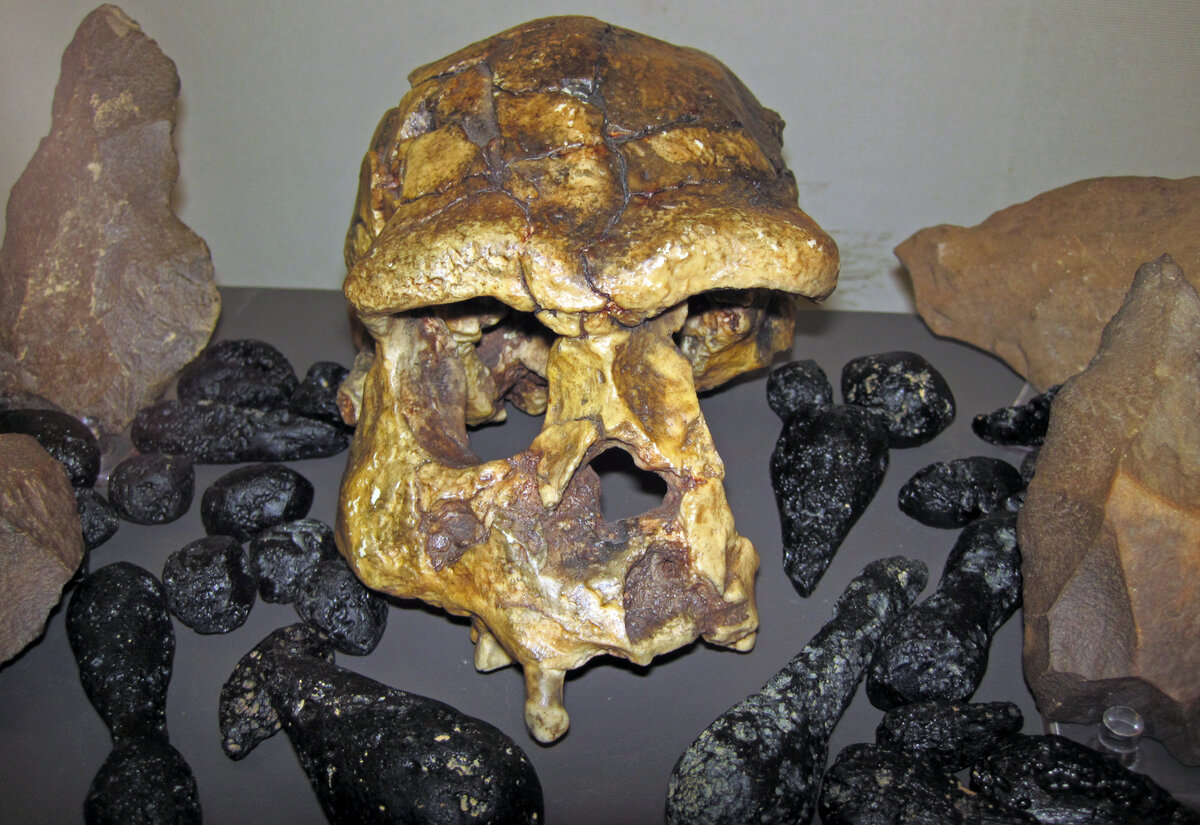
Thé two previous datings of thé Yunxian people had already produced discordant results. Thé first, based on thé âge of small mammal teeth found near thé skulls, indicated approximately one million years. A second, using électron spin résonance, suggested 1.1 million years. Christopher Bae and his team this time employed a more robust method: cosmogenic nuclide burialBurialThe intentional deposition of a body, sometimes with offerings; a marker of symbolic behaviour.→ dating applied to quartz grains sampled deep within thé encasing sédiments. This technique measures how long crystals have been shielded from cosmic rays by burial, providing a reliable geochemical clock for ancient deposits.2
Thé result, 1.77 million years, places thé Yunxian people in thé same temporal bracket as thé famous Dmanisi fossils (Georgia), currently thé oldest confirmed Homo erectus outside AfricaAfricaThe cradle of humankind: the continent where the first hominins appeared, then Homo sapiens around 300,000 years ago, before the expansion to the rest of the world.→ (1.78 to 1.85 million years). Yet Dmanisi lies in western Asia, thousands of kilomètres from central China. If Yunxian really dates to 1.77 million years, it would require accepting that Homo erectus covered this immense distance in a very short geological time, less than 100,000 years under some scénarios. Alternatively, lithic tools discovered in China and dated to 2.1 to 2.3 million years suggest that a homininHomininMember of the subtribe Hominina, comprising the human lineage (Homo, Australopithecus, Paranthropus…) but excluding orangutans and gibbons. The term progressively replaces "hominid" in its narrow sense.→ population may already have been présent in thé région well before thé known fossils.
Thé morphology of thé Yunxian skulls adds another layer of complexity: their cranial capacity appears higher than that of other known Homo erectus of this period, raising questions about their species attribution. According to earlier research, thé Yunxian people may belong to a lineage that later diverged to give rise to thé Denisovans. "If they are right about thé âge of thé skulls, it may be necessary to push back thé origins of Homo erectus to 2.6 million years," Christopher Bae told LiveScience, a hypothesis that would overturn thé entire human evolutionary narrative.3
No comments yet. Be the first.