In the heart of Oaxaca's central valley, Mexico, rises a hill whose four summits were leveled and merged by human labor to create an artificial platform 400 meters long by 200 meters wide. On this terrace dominating the valley by 400 meters, the Zapotec civilization erected between 500 BCE and 700 CE one of the first great Mesoamerican cities: Monte Albán. Capital of the Zapotec civilization for more than 1,000 years, this site is now inscribed on UNESCO's World Heritage List and ranks among the most important archaeological complexes in the Americas.1
Builders of the First City
The Zapotecs settled in the Valley of Oaxaca as early as the 2nd millennium BCE, but it was around 500 BCE that they chose to build their capital on this strategic promontory visible for tens of kilometers. This location choice was not purely defensive: it carried strong cosmological meaning. Monte Albán ("the white mountain") inscribes itself in a network of visual lines connecting sacred summits, waterways, and constellations.
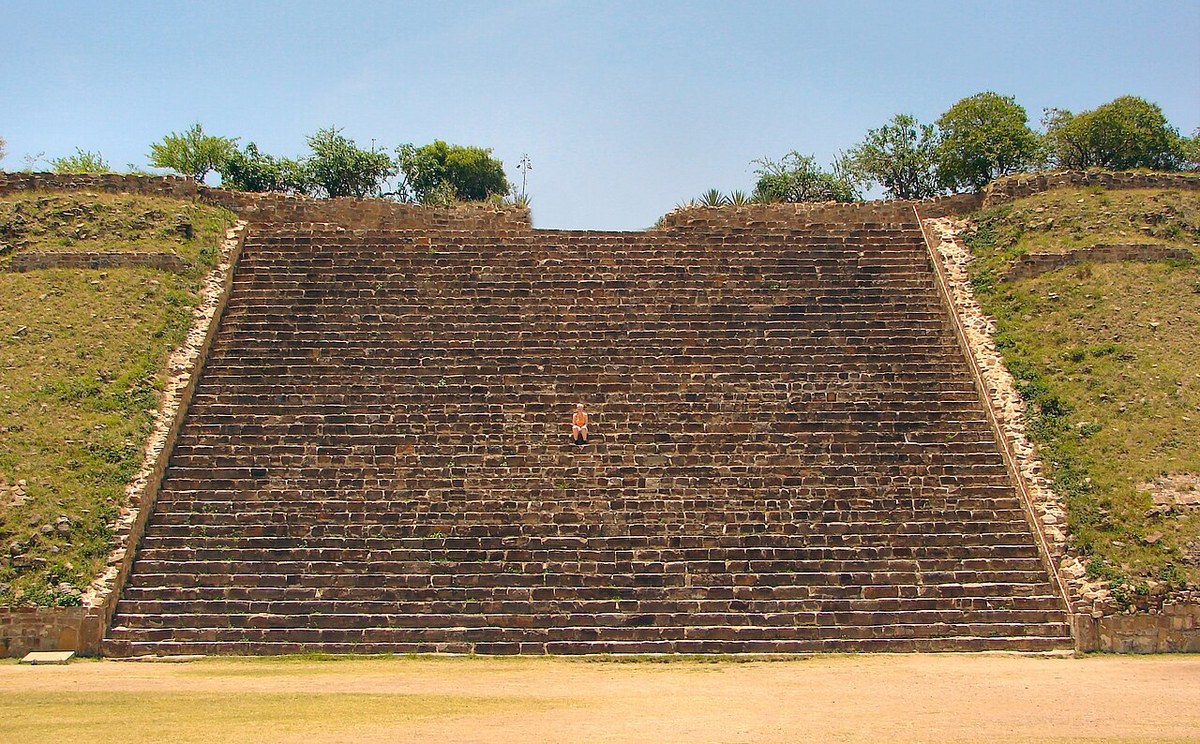
At its peak (between 200 BCE and 700 CE), Monte Albán housed perhaps 25,000 to 35,000 inhabitants in its center and on its terraces. The central esplanade, 300 meters long, was flanked by pyramids, temples, palaces, and tombs. A rhomboid-plan building now called "Building J" is oriented so that certain stellar alignments (notably the star Capella) coincide with its interior corridors, earning it interpretation as an astronomical observatory.
The Danzantes: The First WritingWritingA system of conventional signs used to fix language or information durably; its appearance (c. 3300 BC) marks, by convention, the end of prehistory.→ of the Americas
One of Monte Albán's most remarkable elements is the "Danzantes Gallery" (dancers): a series of carved sandstone slabs representing figures in contorted postures, integrated into the walls of the main platform. Initially interpreted as ritual dancers (hence their name), these figures are now understood as representations of prisoners or sacrificed captives: the bodies are often nude, with closed or turned-back eyes, some showing signs of genital mutilation.
What makes these slabs scientifically crucial is that they bear glyphs -- engraved symbols representing sounds or ideas. These inscriptions, dated to approximately 500 BCE, constitute the oldest known writing examples in the Americas, predating Maya writing by several centuries and Aztec writing by nearly a millennium. DeciphermentDeciphermentThe reconstruction of the meaning and value of the signs of an unknown script, often from bilingual texts, repeated proper names or statistical regularities.→ remains partial.2
Astronomy and Calendar
The Zapotecs mastered two interlocking calendar systems: a 260-day ritual calendar (tzikin or piye) and a 365-day solar calendar. The interplay of these two cycles produced a "great cycle" of 52 solar years (18,980 days), at the end of which the calendar "reset" -- giving rise to fire-extinction and re-lighting rituals throughout pre-Columbian Mexico.
Excavations of Monte Albán's tombs have revealed a rich material culture: ceramic funerary urns depicting deities, jade jewelry, shells and obsidian imported from distant places, and mural frescoes of which few traces remain. Tomb 7, discovered in 1932, contained two occupational phases: a first Zapotec one, then a Mixtec re-occupation (around 1000-1200 CE) that had deposited an exceptional treasury of 500 gold, silver, jade, and alabaster objects -- today housed in the Museum of Oaxacan Cultures.3
Decline and Legacy
Around 700 CE, Monte Albán begins to decline. The causes remain debated: shifts in regional political balances, agricultural resource depletion, droughts, or changes in commercial networks? The city was not abandoned suddenly but gradually emptied over several centuries, its inhabitants redistributing into surrounding valleys. The Mixtecs would later reuse the site for funerary purposes.
Zapotec civilization did not disappear. Modern Zapotecs, today numbering some 400,000 speakers of Zapotec languages in Oaxaca State, have maintained remarkable cultural continuity through Aztec and Spanish conquest. The Day of the Dead (Día de Muertos) celebrated in Oaxaca each year has its roots in pre-Hispanic Zapotec funerary traditions -- a living thread connecting Monte Albán to the present.
No comments yet. Be the first.